
Best Parmesan Grater for Pasta Night (2026 Guide)
We research and evaluate the products we recommend. If you click on links we provide, we may receive compensation.
Best Parmesan Grater for Pasta Night (2026 Guide)
Pre-shredded packaged Parmesan contains cellulose anti-caking agents and potato starch coatings to keep the cheese from clumping in plastic tub containers. These additives block moisture absorption and prevent the cheese from melting smoothly, causing gritty, separated sauces in classic pasta dishes like Cacio e Pepe, Alfredo, and Carbonara.
Grating fresh Parmigiano-Reggiano directly from a cold block yields light, airy ribbons that dissolve instantly into hot pasta water and emulsified butter sauces. This guide evaluates eight top-performing cheese graters—spanning handheld rasps, rotary hand-crank drums, container graters, and traditional box graters—based on blade manufacturing, prep volume, safety features, cleanability, and kitchen storage footprint.
Quick Comparison: Top Parmesan Graters
| Product | Style | Best for | Why it wins | Price |
|---|---|---|---|---|
| Deiss PRO Zester & Grater | Handheld Rasp | Quick individual plating | Photo-etched teeth shear hard blocks effortlessly | Check Price on Amazon |
| Microplane Premium Classic | Handheld Rasp | Fine cheese snow & zesting | Industry-standard USA-made photo-etched blade | Check Price on Amazon |
| Urbanstrive Grater w/ Container | Plane + Catch Tub | Mess-free measured prep | Storage tub captures shreds with markings | Check Price on Amazon |
| Cambom Rotary Grater | Countertop Rotary | High-volume family meals | Hand crank shreds blocks 10x faster | Check Price on Amazon |
| Geedel Rotary Grater | Countertop Rotary | Heavy-duty hand-crank grating | Reinforced gears handle dense rinds | Check Price on Amazon |
| Zyliss Classic Rotary | Handheld Rotary | Tableside serving | NSF-certified, reversible for either hand | Check Price on Amazon |
| OXO Good Grips Rotary | Handheld Rotary | Low-effort, sensitive joints | Soft grips reduce hand strain | Check Price on Amazon |
| KitchenAid Gourmet Box Grater | 4-Sided Box | Multi-ingredient prep | Heavy-gauge frame with catch tub | Check Price on Amazon |
Evaluation Criteria
Picking between these graters comes down to engineering, so we distilled manufacturer specifications into four head-to-head comparison points:
- Blade Technology (Photo-Etched vs. Stamped): Photo-etched teeth are chemically sharpened to cut like tiny scalpel edges, whereas stamped metal blades push and tear cheese. Photo-etching produces lighter, fluffier cheese curls with minimal downward hand pressure.
- Speed & Volume Efficiency: Handheld rasps provide maximum placement accuracy for individual plates, while rotary hand-crank drum mechanisms process large blocks in seconds for multi-portion family cooking.
- Ergonomics & Finger Safety: Features like soft-grip silicone handles, countertop suction bases, and enclosed food pushers determine how safely and comfortably the tool operates under firm pressure.
- Maintenance & Dishwasher Compatibility: We assessed blade clogging tendencies, component breakdown, and long-term dishwasher heat tolerance across plastic and steel assemblies.
Product Reviews
1. Deiss PRO Lemon Zester & Cheese Grater: Best Handheld Rasp
The Deiss PRO is a slim rasp-style grater built with photo-etched stainless steel teeth. Engineered to slice cleanly through dense blocks of Parmigiano-Reggiano, Pecorino Romano, and aged Gouda, it creates fine, ribbon-like shavings that melt upon contact with warm pasta.
The handle is constructed from soft, non-slip silicone that maintains a secure grip even when hands are wet or oily. Non-scratch rubber feet on the tip of the frame anchor the tool against cutting boards or bowl rims, providing stability and protecting ceramic and non-stick surfaces from scratches.
- Who it suits: Home cooks who want light, chef-style cheese ribbons, exact plating placement, and minimal storage footprint.
- Who should skip it: Anyone preparing multi-cup batches for large family meals who wants to avoid manual arm exertion.
Pros:
- Effortless slicing: Photo-etched steel teeth slice cleanly through hard aged cheese blocks without clogging.
- Melt-ready texture: Produces light, airy curls that dissolve evenly into hot pasta sauces.
- Surface protection: Non-scratch rubber tip anchors the frame firmly onto bowls or cutting boards.
- Minimal storage footprint: Flat, narrow profile slides easily into slim utensil drawers.
Cons:
- Requires close hand vigilance when grating down to the remaining rind.
- Blade teeth must be brushed in the direction of the metal to avoid snagging brush bristles.
2. Microplane Premium Classic Series Zester: Best Professional Standard
The Microplane Premium Classic Series Zester is the standard tool used across commercial restaurant kitchens. Microplane pioneered photo-etched culinary rasps, and this flagship model features a narrow stainless steel blade that transforms hard block cheese into fine, snowfall-textured curls with minimal physical effort.
This model includes an ergonomic soft-touch handle and durable plastic side frame covers to prevent the metal edges from scratching countertops or prep bowls. Its rigid stainless steel spine resists flexing even when pressing firmly against hard cheese rinds.
- Who it suits: Precision cooks who want the authentic, commercial-grade tool favored by professional chefs for hard cheese and citrus zest.
- Who should skip it: Cooks seeking an integrated catch container to prevent stray cheese shreds from landing on the counter.
Pros:
- Precision photo-etching: USA-manufactured stainless steel blade delivers consistent, ultra-fine cheese snow.
- Durable frame: Reinforced steel spine prevents bending during heavy pressure on hard aged cheeses.
- Protective end caps: Rubber feet prevent surface scratching on bowls and cutting surfaces.
- Compact profile: Fits standard knife blocks and drawer organizers.
Cons:
- Fine photo-etched teeth can catch and tear standard kitchen sponges during washing.
- Lacks an integrated catch basin; shreds fall directly onto the work surface below.
3. Urbanstrive Cheese Grater with Container: Best Clean-Up Companion
The Urbanstrive Cheese Grater addresses the scattering mess common to handheld rasps by pairing a stainless steel grating plane directly to a fitted plastic container. As cheese is grated across the surface, shreds fall directly into the enclosed tub.
The catch container features integrated volume measurement markings along the side, enabling precise recipe prep without extra measuring cups. An included airtight lid snaps securely onto the container, allowing leftover freshly grated Parmesan to be stored directly in the refrigerator.
- Who it suits: Cooks who hate messy countertop cleanup and want a tool with a built-in measurement tub and storage lid.
- Who should skip it: Users seeking ultra-compact tools that fit flat inside shallow utensil drawers.
Pros:
- Enclosed catch tub: Directs all grated cheese into the container, eliminating countertop cleanup.
- Integrated measurements: Volume markings enable exact recipe prep for sauces and bakes.
- Airtight storage lid: Converts the catch basin into a sealed refrigerator storage container.
- Stable rubber base: Non-slip base ring maintains stability on smooth surfaces during grating.
Cons:
- Clear plastic storage tub should be hand-washed to prevent warping from high dishwasher heat.
- Larger overall size compared to flat, slim handheld rasps.
4. Cambom Rotary Cheese Grater: Best for High-Volume Prep
The Cambom Rotary Cheese Grater is a manual hand-crank machine built for high-volume grating. Utilizing a 360-degree rotating cylinder blade, it processes large quantities of hard block cheese significantly faster than manual hand rasps, making it ideal for family dinners, meal batching, or pizza night.
Operation involves placing cheese chunks into the top hopper, pressing down with the included food pusher, and turning the hand crank. The pusher isolates fingers completely from the internal blades. A high-traction suction lever locks the unit securely to non-porous countertops.
- Who it suits: Busy households that need to shred multi-cup quantities of hard cheese or vegetables in seconds with zero hand fatigue.
- Who should skip it: Kitchens with textured wood, tile grout lines, or unpolished stone countertops where suction bases cannot seal.
Pros:
- High-speed output: Rotary drum processes full blocks of cheese in seconds with minimal arm strain.
- Finger isolation: Food pusher keeps hands fully separated from cutting blades during operation.
- Secure suction lock: Countertop suction base anchors the unit firmly to smooth surfaces.
- Interchangeable drums: Includes three stainless steel drums for fine grating, coarse shredding, and slicing.
Cons:
- Suction base requires a completely smooth, non-porous countertop surface to hold its seal.
- Takes up more vertical cabinet space than handheld options.
5. Geedel Rotary Cheese Grater: Most Durable Hand-Crank Grater
The Geedel Rotary Cheese Grater is constructed with reinforced BPA-free plastic housing designed to resist gear flexing under high torque when processing dense blocks of hard cheeses like aged Parmigiano-Reggiano.
The unit disassembles quickly into individual components, allowing the drum blades and hopper to be cleaned under running water or placed on the top rack of a dishwasher. Its suction base locks the housing to countertops during crank operation.
- Who it suits: High-frequency cooks looking for a sturdy, reinforced hand-crank rotary grater that won’t flex under heavy pressure.
- Who should skip it: Anyone grating small single-portion garnishes who wants to avoid washing multi-part assemblies.
Pros:
- Reinforced housing: Heavy-duty internal drive linkage prevents gear slipping or plastic flex.
- Efficient lever leverage: Rotary drum mechanism reduces wrist effort during long grating sessions.
- Modular disassembly: Internal parts detach quickly for access during cleaning.
- Enclosed cutting zone: Operates with zero direct hand-to-blade contact.
Cons:
- Suction pad does not adhere reliably to textured wood, tile grout lines, or unpolished stone.
- Washing multiple disassembled parts can be inefficient for tiny, single-serving tasks.
6. Zyliss Classic Rotary Cheese Grater: Best Tableside Restaurant Experience
The Zyliss Classic is a compact, handheld rotary grater certified by NSF for commercial hygiene and durability standards. Styled after traditional European tableside graters—popularized in Italian restaurants—it allows users to grate fresh cheese directly over individual plates at the dinner table.
To use, insert a cube of cheese into the hopper, compress the upper lever, and rotate the crank handle. The stainless steel drum grates cheese directly onto pasta plates. The handle and drum assembly can be configured for both right-handed and left-handed operation.
- Who it suits: Diners who love interactive tableside restaurant service and want a compact, NSF-certified handheld rotary grater.
- Who should skip it: Users who dislike pre-cutting large blocks of cheese into small 1.5-inch cubes before grating.
Pros:
- NSF certified: Meets commercial sanitation and material safety standards for food service.
- Ambidextrous design: Reversible handle assembly converts easily for right- or left-handed users.
- Tableside convenience: Compact, handheld design enables direct plating with zero mess.
- Dishwasher safe: Disassembles quickly into top-rack dishwasher-safe components.
Cons:
- Hopper opening requires pre-cutting cheese blocks into smaller 1.5-inch cubes.
- Requires continuous manual squeezing pressure on the upper lever while turning the crank.
7. OXO Good Grips Rotary Grater: Most Ergonomic Rotary Grater
The OXO Good Grips Rotary Grater prioritizes ergonomic comfort, featuring soft, non-slip, pressure-absorbing grips on both the compression lever and the crank handle. It is designed specifically for users managing joint stiffness, arthritis, or limited grip strength.
The hopper accommodates larger blocks of cheese than standard handheld rotary models, reducing pre-cutting time. The internal stainless steel drum geometry is engineered to reduce friction and prevent cheese accumulation inside the cylinder during use.
- Who it suits: Anyone seeking maximum physical comfort, cushioned handles, and low squeezing resistance during tableside grating.
- Who should skip it: Users looking for an all-metal industrial tool without plastic housing components.
Pros:
- Cushioned grips: Soft, non-slip handles absorb pressure and prevent hand fatigue.
- Generous hopper volume: Fits larger cheese portions to reduce pre-cutting prep work.
- Anti-clog drum geometry: Internal cylinder finish reduces friction and cheese buildup.
- Reversible handle: Adjusts easily for right-handed or left-handed operation.
Cons:
- Drum locking mechanism requires precise alignment when reassembling after cleaning.
- ABS plastic body is less rigid than solid stainless steel units.
8. KitchenAid Gourmet Box Grater: Best Multi-Purpose Kitchen Staple
The KitchenAid Gourmet Box Grater is a multi-sided utility grater constructed with heavy-gauge stainless steel walls that resist bending under firm downward pressure. It serves as a broad kitchen tool for households that grate cheese, vegetables, citrus, and spices.
Each side features a distinct cutting surface: fine grating, medium shredding, coarse shredding, and slicing. It includes a fitted plastic storage tub with measurement markings that snaps onto the base to catch shreds during use, along with a snap-on lid for refrigeration.
- Who it suits: Home cooks who want one sturdy, multi-surface tool for hard Parmesan, soft Cheddar, hash browns, and citrus.
- Who should skip it: Kitchens with limited cabinet height or drawers that cannot accommodate bulky box frames.
Pros:
- Four grating surfaces: Handles fine Parmesan grating, coarse cheese shredding, and vegetable slicing.
- Rigid steel walls: Heavy-gauge metal frame withstands firm downward pressure without bowing.
- Integrated catch container: Fitted bottom tub captures shreds and includes a lid for storage.
- Non-slip base frame: Rubber base ring prevents sliding on wet countertops.
Cons:
- Requires significant vertical storage space in cabinets or deep drawers.
- Cleaning the interior walls of the box frame requires a long bottle brush or sponge wand.
Buyer’s Guide: Choosing the Right Grater Style
Selecting the right grater style depends on your primary cooking tasks, batch volume, and storage preferences.
1. Handheld Rasp Graters (Microplane, Deiss PRO)
- Best for: Direct plating, precision control, citrus zesting, and minimal drawer space.
- Characteristics: Long, flat metal planes with photo-etched teeth. They produce delicate, cloud-like cheese ribbons that dissolve instantly into hot pasta sauces.
- Trade-off: Require manual care as the cheese block shrinks near your fingers.
2. Countertop & Handheld Rotary Graters (Cambom, Geedel, Zyliss, OXO)
- Best for: High-volume family meals, fast batch prep, tableside restaurant service, and finger safety.
- Characteristics: Enclosed drum mechanisms turned by a hand crank. Handheld models (Zyliss, OXO) excel at tableside serving, while countertop suction models (Cambom, Geedel) process large blocks rapidly without arm strain.
- Trade-off: Multi-part assemblies take up more storage space and require extra cleaning steps.
3. Container Graters (Urbanstrive)
- Best for: Mess-free recipe prep, precise volume measurements, and built-in refrigerator storage.
- Characteristics: Flat grating planes fitted over a clear storage basin with volume markings and snap-on lids.
- Trade-off: Plastic container requires hand-washing to maintain its shape over time.
4. Box Graters (KitchenAid)
- Best for: All-in-one versatility across hard cheese, soft Cheddar, vegetables, and spices.
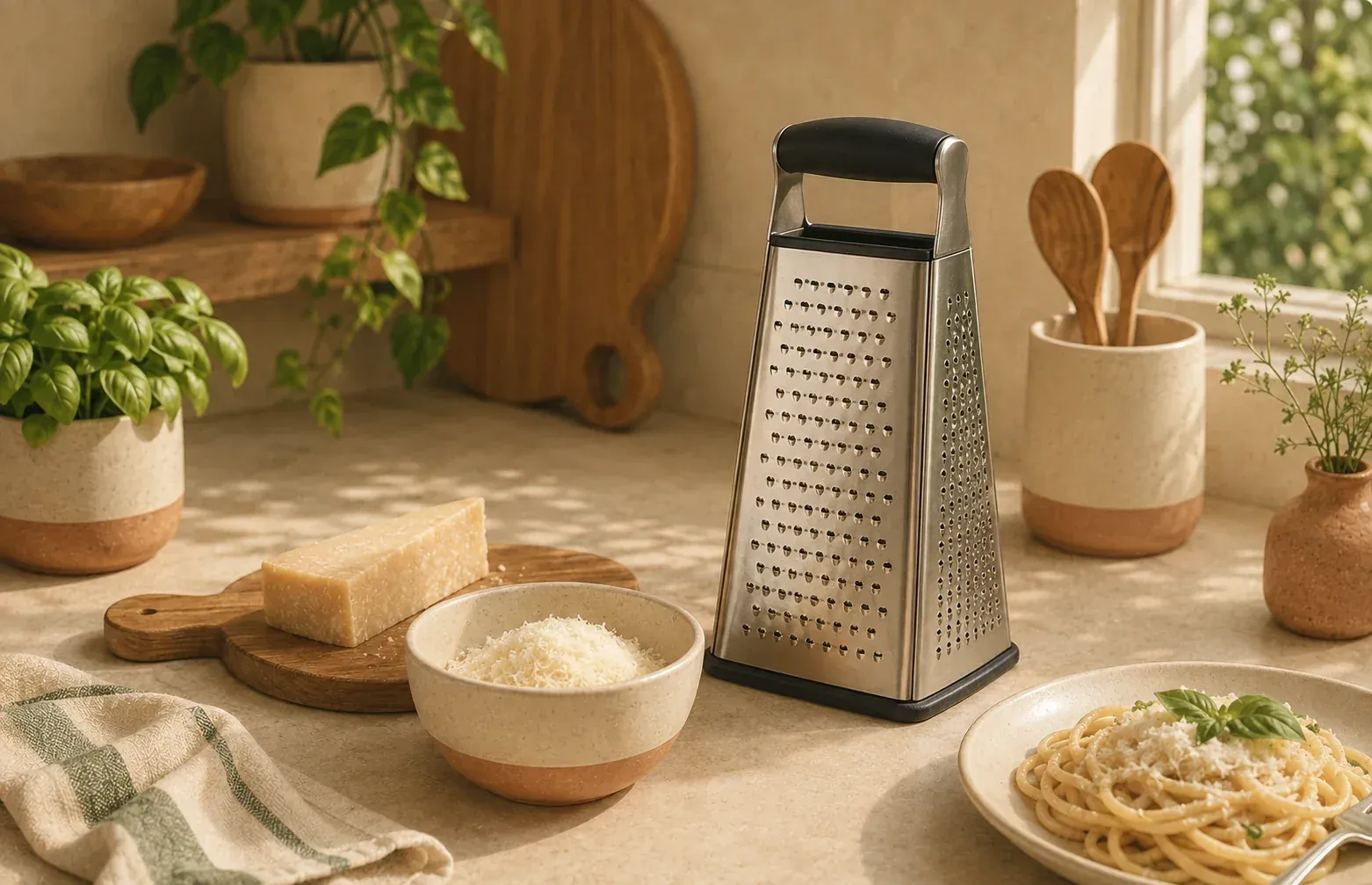
- Characteristics: Four-sided upright stainless steel frames featuring fine, medium, coarse, and slicing blades.
- Trade-off: Bulky footprint requires deep drawer or tall cabinet storage.
Hard vs. Soft Cheese: Matching the Grater to the Ingredient
Different cheese varieties possess varying moisture and fat contents, which dictate the correct grater choice:
- Hard Aged Cheeses (Parmigiano-Reggiano, Pecorino Romano, Asiago, Aged Gouda): Low moisture content allows these cheeses to be sheared by fine photo-etched rasps or rotary drums without clogging. They yield fine ribbons or light powder.
- Medium to Soft Cheeses (Young Cheddar, Mozzarella, Monterey Jack, Gouda): High moisture and fat contents cause soft cheeses to mash and clog fine rasp teeth. Soft cheeses require the coarse shredding drum of a rotary grater or the large holes of a box grater.
Note on Stand Mixers & Electric Graters: Stand mixer attachments (like KitchenAid rotor attachments) or motorized electric graters suit commercial operations or massive batch prep. However, for everyday pasta nights, manual hand-crank rotary units and handheld rasps offer superior setup speed, easier cleaning, and better control without pulling out heavy electrical appliances.
3 Critical Mistakes to Avoid When Grating Hard Cheese
- Washing Fine Photo-Etched Blades in High-Heat Dishwashers: While stainless steel is water-resistant, high dishwasher heat, harsh detergents, and physical contact with other utensils dull photo-etched metal teeth over time. Hand-wash fine rasps with warm water, mild soap, and a soft nylon brush.
- Using Pre-Shredded Packaged Cheese for Hot Sauces: Pre-shredded packaged cheese is coated with potato starch or cellulose powder to prevent clumping. These additives disrupt melting, causing sauce breakdown and oily separation in dishes like Cacio e Pepe and Carbonara.
- Grating Warm Cheese at Room Temperature: Hard cheeses grate cleanest when cold. At room temperature, milk fats soften, causing the cheese block to smear and clog fine grater teeth. Keep your Parmigiano-Reggiano refrigerated until the exact moment you begin grating.
Frequently Asked Questions
Why does fresh-grated Parmesan melt better than packaged pre-shredded cheese?
Pre-shredded cheese in plastic tub packages contains added anti-caking agents (cellulose) and starches to keep shreds separated. These additives absorb moisture and prevent cheese from melting into a smooth emulsion, resulting in clumpy, oily pasta sauces. Freshly grated cheese retains its natural fats and dissolves smoothly into warm pasta water.
How do you clean dried cheese from fine rasp teeth and rotary drums safely?
Soak the grater blade in warm, soapy water for 5 minutes to soften hardened cheese particles. Wash using a soft nylon bristle brush, moving the bristles in the direction of the metal teeth or from the back of the blade frame to avoid cutting the brush or your fingers.
Is the OXO or Zyliss rotary cheese grater dishwasher safe?
The Zyliss Classic Rotary disassembles into top-rack dishwasher-safe components. The OXO Good Grips Rotary can also be placed on the top rack of a dishwasher, though hand-washing the stainless steel drum extends blade sharpness over long-term use.
Can soft cheeses like Mozzarella or Cheddar be grated on a fine hand rasp?
No. Fine photo-etched rasps are designed specifically for hard, low-moisture cheeses. Soft cheeses contain high moisture and fat that mash and clog fine teeth. Use the coarse shredding drum of a rotary grater or the coarse side of a box grater for soft cheeses.
Final Verdict
- For Chef-Grade Precision & Light Curls: Choose the Microplane Premium Classic Zester or Deiss PRO. Their photo-etched blades deliver ultra-fine shavings for professional plating.
- For Ergonomics & Joint Comfort: Select the OXO Good Grips Rotary Grater. Its cushioned handles absorb pressure and simplify tableside grating.
- For High-Volume Family Meals: Opt for the Geedel Rotary Cheese Grater or Cambom Rotary Grater. Their hand-cranked drum mechanisms process large blocks in seconds with complete finger protection.
- For Mess-Free Measured Prep: Choose the Urbanstrive Cheese Grater with Container to capture all shreds directly in a side-marked storage tub.
- For All-Around Kitchen Prep: Choose the KitchenAid Gourmet Box Grater for multi-surface utility across cheese, vegetables, and spices.
About the Author
Kadri Blahoslav is a kitchen gear reviewer and culinary writer specializing in kitchen tool testing, food prep efficiency, and small-appliance ergonomics. He spends his weeks comparing blade designs, prep workflows, and cleanup trade-offs across rasps, rotary graters, and box graters. In this guide he focuses on manufacturer specifications and practical kitchen use so readers can match the right grater to their cooking style.